Travel Insurance for Autism: What Families Must Know

Travel insurance can cover emergency medical care and evacuation for autistic travelers, but it almost never pays for sensory accommodations, planned therapy sessions, or personal support staff. Think of it as a financial backstop for medical catastrophes, not a substitute for sensory-first planning.
Act now:
- Disclose autism and any related diagnoses honestly on every application — undisclosed conditions can void a policy entirely when you file a claim.
- Build your real safety net by pairing a solid policy with specialized planning support like Travel with Chance, airport programs like TSA Cares, and your rights under the Air Carrier Access Act.
Read the documentation and timeline section first if you've already booked a trip — the waiver buy-by window may still be open.
Table of Contents
- What travel insurance actually covers for autistic travelers
- How disclosing autism affects your policy and your claims
- Policy features worth prioritizing for neurodivergent travelers
- Documentation to prepare and when to buy your policy
- Practical alternatives that insurance will never replace
- How to choose and buy the right policy
- When insurance helps most, and when planning is the better investment
- Travel with Chance fills the gaps insurance leaves open
- Key takeaways
- A note on pairing insurance with sensory-first planning
- Useful U.S. resources to read next
What travel insurance actually covers for autistic travelers
Standard policies protect against financial emergencies, not predictable support needs. Here's the honest breakdown.
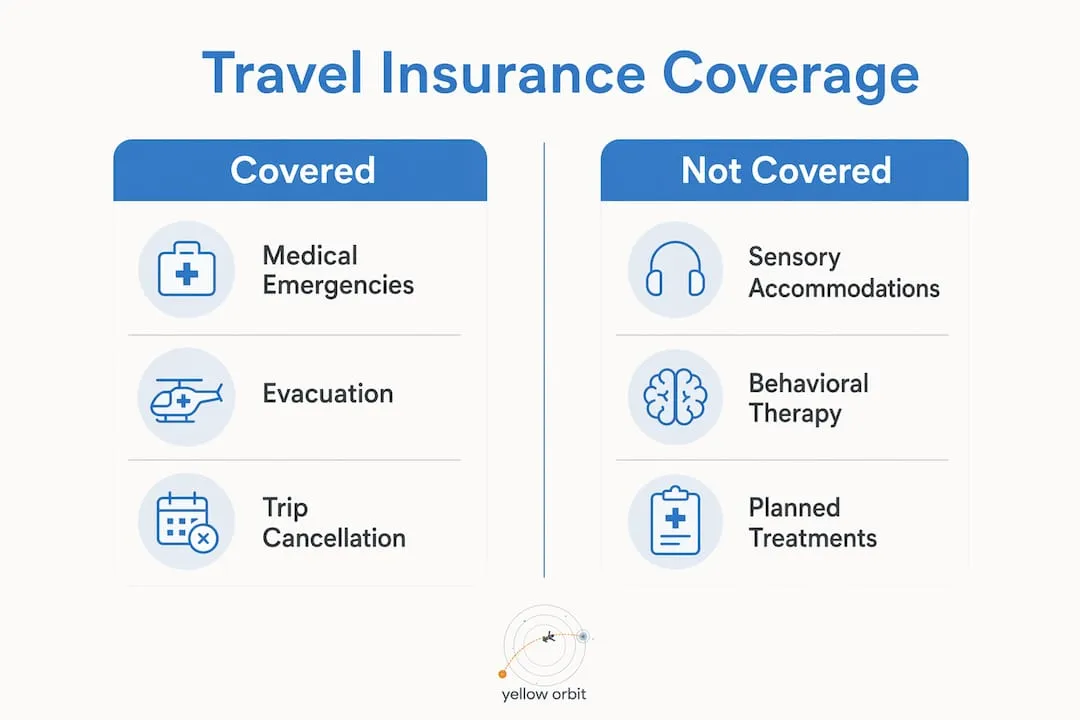
What's typically covered:
- Emergency medical treatment (ER visits, hospitalization, urgent care abroad)
- Emergency medical evacuation and repatriation
- Trip cancellation or interruption caused by a covered reason (sudden illness, death of a family member, severe weather)
- Baggage loss, theft, or delay
- 24/7 assistance hotlines
What's almost never covered:
- Routine or ongoing behavioral therapy
- Planned ABA sessions or occupational therapy during a trip
- Non-medical personal support staff or hired companions
- Sensory-friendly room upgrades or noise-canceling equipment
- Trip cancellation due to anxiety, when the policy carries a mental-health exclusion
A quick illustration: if your child develops heatstroke at a theme park and needs an ER visit, a standard policy pays. If you pre-booked a sensory room upgrade that the hotel cancels, insurance won't cover that — budget for it separately.
The rule of thumb: Insurance is a risk-transfer tool for unexpected medical events. Predictable sensory and routine-support costs are a planning problem, not an insurance problem.
Legal transport protections are a separate channel entirely. The Air Carrier Access Act and U.S. DOT rules require airlines to provide nondiscriminatory treatment and certain accessibility supports. TSA Cares offers a dedicated helpline and advance notification for travelers who need extra time or communication support during screening. Neither program is insurance, but both reduce the situations where you'd need to file a claim in the first place.

How disclosing autism affects your policy and your claims
Honesty here is not optional. When travelers fail to disclose relevant diagnoses and later file claims, insurers routinely pull pharmacy and medical records. Undisclosed conditions can trigger retroactive policy voidance and repayment demands — a far worse outcome than a higher premium upfront.
What insurers will ask you:
- What is the diagnosis, and when was it made?
- Have there been any hospitalizations related to the condition in the past 12–24 months?
- Are you currently on medication, and has the dosage changed recently?
- Have you seen a specialist or therapist in the past 60–180 days?
- Is the condition considered stable, and what does "stable" mean per your doctor?
What happens after you disclose:
Budget carriers often apply automatic exclusions or flat-out reject applications that mention ADHD, autism, or mental-health diagnoses. Mid-tier and specialty insurers are more likely to perform human underwriting, request medical records, and approve conditionally. Premium or specialty plans may cover autism-related emergency medical events after reviewing your records.
Pro Tip: Document every insurer conversation. Screenshot policy wording, save email confirmations, and if a customer service rep makes a verbal exception, follow up immediately in writing and ask them to confirm it by email. Verbal promises don't survive claims reviews.
Policy features worth prioritizing for neurodivergent travelers
Not all coverage is equal. Here's how to rank what matters.
Must-have features:
- Emergency medical coverage with adequate limits for your destination
- Emergency evacuation and medical repatriation
- 24/7 assistance hotline with multilingual support
- Baggage delay and loss coverage (medication and sensory equipment are expensive to replace)
- Clear, explicit policy language on mental health and neurodivergent conditions — vague wording almost always resolves against the claimant
Nice-to-have features:
- Pre-existing condition waiver (see the timeline section below)
- Cancel for Any Reason (CFAR) coverage, which typically reimburses 50–75% of nonrefundable costs for any reason
- Prescription medication replacement coverage
- Reasonable medical repatriation limits
Often not worth paying for:
- Policies that advertise "concierge comfort upgrades" — these are marketing language, not insurance benefits
- Blanket behavioral therapy coverage promises, which rarely survive the policy fine print
Mini-glossary:
- CFAR (Cancel for Any Reason): An add-on that lets you cancel for reasons not listed in the base policy, usually reimbursing 50–75% of nonrefundable costs.
- Pre-existing condition waiver: Removes the exclusion for a known condition if you buy the policy within the insurer's purchase window.
- Look-back period: The window of time (commonly 60–180 days) before your policy purchase date that insurers review for condition changes.
- Medical evacuation: Emergency transport to the nearest adequate medical facility or back home.
- Policy effective date: The date coverage actually begins — not the purchase date in some cases.
Documentation to prepare and when to buy your policy
Timing is the single most consequential decision in this process. A pre-existing condition waiver is often the only way to convert an excluded condition into covered emergency risk — and missing the buy window closes that option permanently.
Timeline at a glance:
| Milestone | Typical window | Action required |
|---|---|---|
| Book first trip payment | Day 0 | Start shopping for policies immediately |
| Buy-by window for waiver | within 14–21 days after first payment | Purchase policy and insure all nonrefundable costs |
| Look-back period reviewed | 60–180 days before purchase | Ensure no recent medication changes or hospitalizations |
| Policy effective date | Varies by insurer | Confirm when coverage actually starts |
Document checklist to prepare before you travel:
- Doctor's letter summarizing the diagnosis, current stability, and any medications
- Medication list with dosages and generic names (for replacement abroad)
- Treatment history with dates (for underwriting and claims)
- Emergency contacts and caregiver details in writing
- Copies of prescriptions in a separate bag from the originals
- Printable care plan summary with communication preferences and sensory triggers
- Receipts and photos of any high-value sensory equipment in your luggage
Keep digital copies in cloud storage and physical copies in two separate bags. For claims, contemporaneous notes, receipts, and email copies of insurer conversations are your strongest evidence.
Practical alternatives that insurance will never replace
Insurance covers what goes wrong. Planning prevents it. Predictable itineraries and sensory-vetted environments reduce the situations where you'd need to file a claim at all.
Concrete supports to layer in:
- TSA Cares: Call 72 hours before departure to request a passenger support specialist for security screening. Free, no paperwork required.
- Airline disability services: Request pre-boarding, wheelchair assistance, or a quiet waiting area through the airline directly — the Air Carrier Access Act requires airlines to accommodate these requests.
- Sensory-vetted accommodations: Hotels and vacation rentals pre-screened for noise levels, lighting, and proximity to high-stimulation areas.
- Airport meet-and-assist: Many major airports offer escort services from check-in through the gate.
- Visual step-by-step guides: Printed or digital walkthroughs of each leg of the trip, including what the security line looks like and where the quiet rooms are.
The gap insurance can't close: A traveler with a solid policy and no sensory-vetted plan still faces unpredictable environments, unexpected route changes, and communication breakdowns. A traveler with a sensory-first plan and basic insurance covers both the financial and experiential risks. The combination is the strategy.
The ACAA and DOT protections cover what airlines must do. Insurance covers what you lose financially when things go wrong. Specialized planning reduces how often either channel gets tested.
How to choose and buy the right policy
Buying checklist:
- Confirm emergency medical limits are adequate for your destination (international travel warrants higher limits)
- Check evacuation and repatriation coverage explicitly
- Read the mental health and neurodivergent condition language word for word
- Verify pre-existing condition waiver availability and the exact buy-by window
- Ask about CFAR availability and the reimbursement percentage
- Confirm 24/7 assistance availability and whether the hotline has communication support options
- Check prescription replacement coverage
Scripted questions to ask insurers:
- "Does this policy exclude autism or neurodivergent diagnoses from emergency medical coverage?"
- "What is your look-back period, and what counts as a change in condition?"
- "What is the exact deadline to purchase a pre-existing condition waiver after my first trip payment?"
- "Will you confirm in writing that [specific condition] is covered under this policy?"
- "If I need to cancel due to a mental-health-related emergency, is that a covered reason?"
Practical buying rules:
- Buy within the waiver window shortly after your first trip payment, as this timing is most commonly required.
- Insure 100% of nonrefundable trip costs if the waiver requires it; partial insuring often voids the waiver.
- Get every confirmation in writing before you travel.
When insurance helps most, and when planning is the better investment
The honest verdict: Insurance meaningfully reduces financial risk for cross-border medical emergencies, remote travel, and high-cost evacuations. For sensory environments, predictable routines, and on-the-ground support, planning is the higher-return investment — insurance won't pay for those things regardless of how good the policy is.
Prioritize insurance when:
- Traveling internationally or to remote areas with limited medical infrastructure
- The trip involves significant nonrefundable costs
- A medical emergency would create catastrophic out-of-pocket exposure
Prioritize planning when:
- Sensory overload, routine disruption, or communication challenges are the primary risks
- The traveler needs on-the-ground support that no policy will reimburse
- Predictability and pre-vetted environments are what actually determine whether the trip succeeds
Insurance and planning solve different problems. Treating one as a substitute for the other is where most families get caught short.
Travel with Chance fills the gaps insurance leaves open
Good insurance handles the financial emergency. It does nothing about the sensory chaos at a crowded airport, an unexpected gate change, or a hotel room that turns out to be next to a construction site.
Travel with Chance is a neurodivergent-focused travel planning service that handles exactly what insurance can't: sensory-vetted accommodations, frictionless flight and train routing, detailed visual guides for every leg of the trip, real-time disruption monitoring, and live rerouting when plans change. There are two ways to work together: booking assistance at no planning fee, or custom trip planning for a flat $250. It's not insurance, and it doesn't replace it. It closes the practical gaps insurance was never designed to fill. If you're planning a trip and want the environment pre-vetted before you arrive, reach out to Travel with Chance to discuss your trip's needs.
Key takeaways
Travel insurance covers emergency medical events for autistic travelers but excludes sensory accommodations, planned therapy, and personal support staff — pairing a waiver-triggered policy with sensory-first planning gives the most complete protection.
| Point | Details |
|---|---|
| What insurance covers | Emergency medical, evacuation, trip cancellation for covered reasons, and baggage loss or delay. |
| What insurance won't cover | Sensory upgrades, personal support staff, routine therapy, and most anxiety-related cancellations. |
| Timing is critical | Buy within 14–21 days of your first trip payment to trigger a pre-existing condition waiver. |
| Documentation matters | Carry a doctor's letter, medication list, care plan summary, and receipts for all high-value equipment. |
| Travel with Chance | Fills the planning gaps insurance leaves open — sensory-vetted routes, real-time support, and backup plans. |
A note on pairing insurance with sensory-first planning
The families who travel most successfully with a neurodivergent member aren't the ones with the most expensive policies. They're the ones who treated the trip environment as something to engineer, not something to insure against. Insurance is the right tool for financial catastrophe. Sensory-vetted planning is the right tool for everything else — the predictable friction, the communication challenges, the environments that can make or break a trip before anything goes medically wrong. The practical case for combining both is straightforward: one covers what you can't anticipate, the other handles what you absolutely can.
Useful U.S. resources to read next
- U.S. DOT / Air Carrier Access Act guidance — What airlines are legally required to provide for travelers with disabilities; your starting point for understanding transport rights separate from insurance.
- TSA Cares (tsa.gov/travel/passenger-support) — Free pre-notification program for travelers who need extra support during airport security screening; call 72 hours before departure.
- CDC Travelers' Health — Travelers with Disabilities (ncbi.nlm.nih.gov) — Practical health and safety guidance for travelers with disabilities, including pre-trip medical preparation.
- Your state insurance department (naic.org/state_web_map.htm) — File complaints, verify insurer licenses, and get consumer guidance on denied claims in your state.
- Forbes Advisor — Travel Insurance for Pre-Existing Conditions — Clear breakdown of look-back periods, waiver rules, and how to compare policies when you have a disclosed condition.