Flying with Medication: A Low-Stress Guide for Neurodivergent Travelers

You can fly with prescription and over-the-counter medications in your carry-on or checked bags. Full stop. The rules are manageable once you know them, and with a little prep, the security checkpoint becomes far less of an unknown.
30-second plan:
- Declare medications at the checkpoint before screening begins
- Remove meds from your bag and place them in a separate bin
- Carry your prescription and a doctor's letter that includes generic drug names
- Pack a backup supply and any cooling gear your medication requires
- Contact your airline in advance if you need pre-boarding or refrigerated storage
- Call or register with TSA Cares before your flight if you want a Passenger Support Specialist
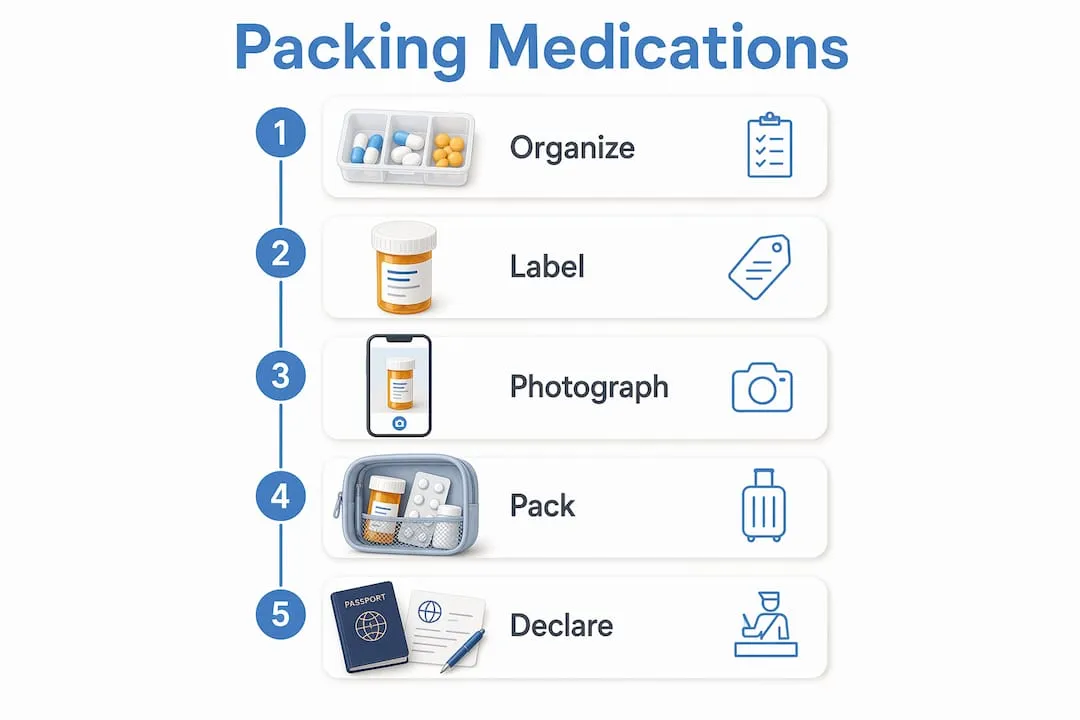
Pro Tip: Put all medications in a single clear, labeled pouch before you leave home. Then photograph every bottle label, prescription, and doctor's letter on your phone and back them up to the cloud. If something goes wrong at the airport or abroad, you have everything you need in your pocket.
Table of Contents
- What are the TSA rules for flying with medication?
- What documentation should you carry when traveling with prescriptions?
- How should you pack medications for a low-sensory experience?
- How do you fly with injectables, pumps, syringes, and sharps?
- How do you manage medications and sensory needs during the flight?
- What do you need to know about international travel and medication legality?
- What should you do if medication is lost, delayed, or confiscated?
- Pre-flight medication checklist (print and use)
- Key Takeaways
- What most medication travel guides miss
- How Travel with Chance takes the planning load off you
- Primary sources and useful links
What are the TSA rules for flying with medication?
TSA medication rules allow pills in both carry-on and checked baggage, and they recommend keeping meds clearly labeled to speed up screening. Liquid medications get a specific exemption: medically necessary liquids over 3.4 oz are permitted in carry-on when declared at the checkpoint. That said, oversized liquids may still go through additional screening and could be refused if they trigger an alarm.
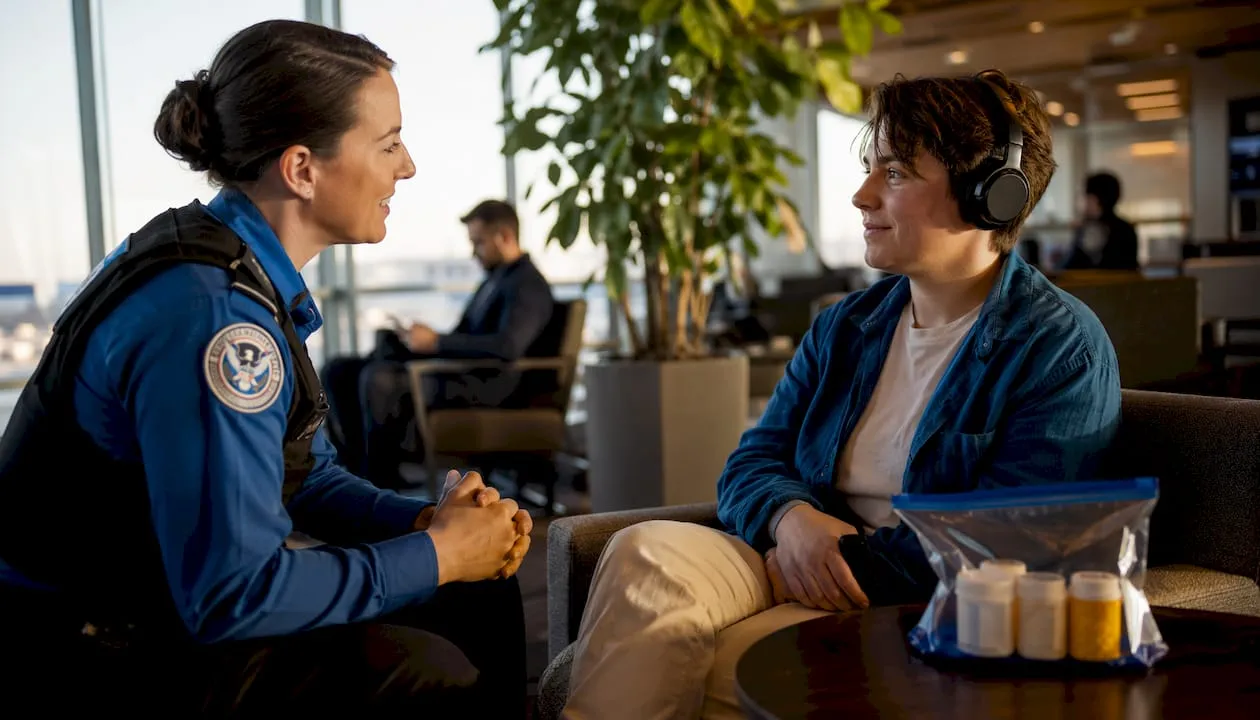
One thing worth knowing: the final call belongs to the TSA officer on duty. Declaring your medications upfront is the single most effective step you can take, because it prompts officers to apply appropriate screening protocols rather than default restrictions.
At the checkpoint, here's what reduces friction:
- Arrive early so you're not rushed
- Remove medications from your bag before reaching the belt
- Place them in a separate bin, clearly visible
- Tell the officer "I have declared medications" before the bin goes through
- Request a Passenger Support Specialist through TSA Cares if you want a quieter, pre-planned interaction
Callout: Requesting alternative screening (opting out of X-ray for liquid medications) is your right, but it triggers a mandatory pat-down and more extensive screening of your carry-on. For neurodivergent travelers, that trade-off can mean more sensory stress, not less. Plan for it ahead of time rather than deciding on the spot.
Pro Tip: Register with TSA Cares at least 72 hours before your flight. A Passenger Support Specialist can meet you at the checkpoint, walk you through each step, and reduce unexpected interactions.
What documentation should you carry when traveling with prescriptions?
A prescription alone is a good start. A doctor's letter is better. Together, they cover you at the checkpoint, at international borders, and at a foreign pharmacy if you need an emergency refill.
Your doctor's letter should include:
- Your full name
- The medication's brand name and generic name
- Dosage, form (tablet, liquid, injectable), and directions for use
- The medical reason for the medication
- An explanation of any device (pump, injector, sharps case)
- Your doctor's name, contact information, and signature
Generic names matter more than you might expect. Brand names for the same drug often differ by country, so a prescription that only lists a brand name can confuse a foreign pharmacist or border official. Carrying generic names on your documents is the fix.
Store copies in three places: a photo on your phone, a cloud backup (Google Drive or iCloud), and a printed copy in a separate bag from your medications.
For international travel, check the U.S. Embassy website for your destination country before you fly. Some medications legal in the U.S. are restricted or prohibited elsewhere, including certain ADHD medications and controlled substances. The U.S. Department of State's embassy finder is the right starting point.
Pro Tip: When traveling internationally, ask your doctor to write a second copy of the letter specifically listing the generic name and INN (International Nonproprietary Name) of each medication. It takes one extra minute at the appointment and can save hours at a foreign border.
How should you pack medications for a low-sensory experience?
One clear soft pouch. That's the system. Everything active goes in it, it comes out as one unit at the checkpoint, and you never have to dig through a bag under fluorescent lights while someone waits.
| Storage option | Best for | Sensory profile | TSA screening behavior |
|---|---|---|---|
| Clear zip pouch | Daily pills, liquids, small devices | Low tactile, easy to scan visually | Comes out as one unit, minimal handling |
| Pill organizer (labeled) | Multi-medication schedules | Reduces decision fatigue | Transparent lids speed visual check |
| Insulated/refrigerated case | Insulin, biologics, temperature-sensitive meds | Bulkier, but predictable | Declare separately; may require additional screening |
For liquid medications, keep them accessible at the top of your carry-on so you're not unpacking everything at the belt. Medically necessary liquids over 3.4 oz must be declared, but they don't need to go in a quart-sized bag. If a liquid alarms during screening and can't be cleared, it may not be allowed through. For anything you're uncertain about, a backup in checked baggage is a reasonable hedge.
Label the outside of your pouch and each container with the generic drug name and dose. It reduces verbal back-and-forth with officers, which matters when you're already managing sensory load.
Pro Tip: Freeze gel packs at home and pack them in a small insulated bag. TSA allows frozen solid ice packs; partially melted ones may be refused. Freeze them solid before travel.
How do you fly with injectables, pumps, syringes, and sharps?
Pack syringes, insulin pumps, IV bags, and sharps cases together in a clearly labeled pouch or rigid case. Insulin pumps and similar devices may be screened by X-ray if they can be disconnected. If a device cannot be removed, tell the officer before screening and expect a careful, gentle manual inspection.
Key steps for devices and sharps:
- Declare all devices and accessories before the bin goes through
- Place device accessories (tubing, cartridges, alcohol wipes) in a separate bin
- Keep lithium batteries for powered devices in your carry-on, not checked baggage, per airline policy
- Check your device manufacturer's guidance on X-ray compatibility before travel
Callout: Opting out of X-ray for a device or liquid triggers additional screening steps including AIT screening and a pat-down. For travelers who find unexpected physical contact distressing, contacting TSA Cares in advance to pre-arrange the process makes a real difference.
Pro Tip: Bring a printed note from your doctor specifically describing the device, why it cannot be removed, and what it looks like. Handing a card to an officer is faster and less stressful than explaining verbally under pressure.
How do you manage medications and sensory needs during the flight?
Time zones are the trickiest part of in-flight medication management. A simple approach: keep dosing on your home time zone for short trips (under 3 days). For longer trips, shift your dose time by 1–2 hours per day starting a few days before departure. Set quiet alarms on your phone or watch, not just one, so a missed alert doesn't throw off your schedule.
Low-sensory tools worth packing:
- Noise-canceling earbuds or headphones (reduces cabin noise significantly)
- A written dosing schedule on a small card, not just a phone app
- Pre-portioned medications in a labeled daily pouch to eliminate in-flight decisions
- A short written cue card to hand to flight crew if you need assistance without a long verbal exchange
If you need crew help, brief is better. Something like: "I take medication at a specific time. I may need a glass of water at [time]. I'll let you know." Most crew respond well to clear, short requests. Pre-boarding, which you can request through your airline's accessibility or medical desk, gives you time to settle before the cabin fills.
What do you need to know about international travel and medication legality?
Medication rules vary sharply by country. Some ADHD medications, opioids, and controlled substances that are legal in the U.S. are restricted or outright prohibited in other countries. Check destination regulations using the U.S. Embassy at your destination and the International Narcotics Control Board (INCB) website for controlled substances.
Transit countries count too. If your layover is in a country with strict drug laws, your medications may be subject to those rules even if you never leave the airport. Check every country your itinerary touches, not just your final destination.
When a simple generic-name prescription is enough versus when you need a notarized letter depends on the destination. For most Western European countries, a signed doctor's letter with generic names suffices. For countries with stricter controlled-substance rules, a notarized letter or official translation may be required. The U.S. Embassy at your destination can confirm what's needed.
Pro Tip: Pack extra prescriptions in a separate bag from your main supply. If one bag is lost or delayed, you still have documentation to request an emergency refill locally.
What should you do if medication is lost, delayed, or confiscated?
Act in this order:
- Notify the airline immediately and file a lost baggage or incident report
- Contact the local U.S. Embassy or consulate if you're abroad; they can direct you to local medical resources and assist with documentation
- Use your prescription copies and doctor's letter to request an emergency refill at a local pharmacy
- Call your prescribing doctor or home pharmacy to ask about emergency transfer or early refill authorization
- If you're without a critical medication and cannot get a refill quickly, go to an urgent care clinic or hospital and bring all documentation you have
- When speaking to medical staff abroad, lead with the generic name and dosage, not the brand name
Pro Tip: Create a small emergency card, physical and digital, listing each medication's generic name, dose, your doctor's name and phone number, and your home pharmacy's number. Keep the physical card in your wallet, separate from your medication bag.
Pre-flight medication checklist (print and use)
What to pack:
- [ ] Medications in original, labeled containers inside a clear pouch
- [ ] Prescription copies with generic names
- [ ] Doctor's letter (brand name, generic name, dosage, medical necessity, device description)
- [ ] Backup supply (at least 2–3 extra days' worth)
- [ ] Cooling gear if required (frozen solid ice packs, insulated case)
- [ ] Sharps container if applicable
What to confirm:
- [ ] Phone photos of all labels, prescriptions, and doctor's letter backed up to cloud
- [ ] TSA Cares registered (at least 72 hours before flight)
- [ ] Airline notified of pre-boarding need or refrigeration request
- [ ] Destination and transit-country medication rules checked via U.S. Embassy
- [ ] Emergency card created with medication names, doses, and contacts
- [ ] Dosing schedule written out for time-zone adjustment
Key Takeaways
Flying with medication is manageable when you declare, document, and separate — and TSA Cares can reduce sensory stress at the checkpoint before you ever reach the belt.
| Point | Details |
|---|---|
| Declare at the checkpoint | Tell the TSA officer about medications before screening; it triggers appropriate protocols, not default restrictions. |
| Carry generic drug names | Brand names differ internationally; generic names on prescriptions and doctor's letters work at foreign pharmacies and borders. |
| Use TSA Cares in advance | Register in advance before your flight to arrange a Passenger Support Specialist and a quieter screening interaction. |
| Pack a backup supply | Keep extra doses and prescription copies in a separate bag in case luggage is lost or delayed. |
| Travel with Chance support | Travel with Chance handles TSA Cares coordination, airline pre-notification, and visual travel guides as part of Travel with Chance's neurodivergent travel planning service. |
What most medication travel guides miss
The standard advice, declare your meds, carry a doctor's letter, use TSA Cares, is correct. But it treats the checkpoint as the only hard part. For neurodivergent travelers, the checkpoint is often the most predictable part of the trip, because it has rules. The harder moments are the ones nobody plans for: the gate agent who doesn't know your pre-boarding request was filed, the flight delay that throws off a timed medication schedule, the foreign pharmacy where your brand name draws a blank.
The real gap in most guides is the absence of a contingency layer. Knowing what to do when something goes wrong, having the emergency card, the backup prescription, the embassy contact, the written dosing schedule, is what actually keeps a trip from unraveling. Preparation for the expected is table stakes. Preparation for the unexpected is what separates a stressful trip from a manageable one.
How Travel with Chance takes the planning load off you
Medication travel prep has a lot of moving parts, and managing all of them while also planning a trip is a real cognitive load. Travel with Chance handles the logistics that typically fall through the cracks: TSA Cares registration on your behalf, airline pre-notification for pre-boarding and refrigeration needs, and a visual travel guide built around your specific itinerary and medication schedule.
Custom trip planning includes a medication checklist and travel-day support, with monitoring and rerouting if something goes wrong. For families and caregivers, that live-day layer means someone is watching your trip while you focus on the people you're traveling with.
If you want help building a medication travel plan that accounts for your sensory needs, time zones, and destination rules, start with a free consultation.
Primary sources and useful links
- TSA: Medications (Pills) — Confirms pills are allowed in carry-on and checked bags; use this to verify checkpoint procedure for solid medications.
- TSA: Liquids, Aerosols, and Gels Rule — Explains the medically necessary liquid exemption over 3.4 oz; check this before packing liquid medications.
- TSA Cares: Disabilities and Medical Conditions — Register here for a Passenger Support Specialist; also explains alternative screening trade-offs.
- TSA: Medical Devices — Covers insulin pumps, injectables, and devices; use this to understand what to expect if a device cannot be disconnected.
- TSA: FAQ on Traveling with Medication — Explains officer discretion and the importance of declaring items; good reference for checkpoint questions.
- Healthline: How to Travel with Medication — Practical packing and documentation tips, including generic name guidance for international travel.
- U.S. Department of State: Embassy Finder — Use this to locate the U.S. Embassy at your destination for local medication rules and emergency consular assistance.
- Travel with Chance: Neurodivergent Travel Planning — Primary resource for booking neurodivergent travel planning services, including medication prep, TSA Cares coordination, and live travel-day support.
This article is general information, not medical or legal advice. Confirm current rules with the TSA, your destination's U.S. Embassy, and your prescribing physician before you travel.