Airport Lounge Access for Neurodivergent Travelers

You can reliably secure low-sensory airport lounge time by combining advance enrollment, a real-time location check, and a pre-arrival request to lounge staff. Travel with Chance, TSA Cares, and networks like Priority Pass (operated by Collinson) give you three separate levers to pull before you reach the terminal.
Before your trip, work through this checklist:
- Confirm the lounge exists at your specific terminal and is within walking distance of your gate
- Activate your membership through your card issuer's portal — the physical card alone may not grant entry
- Check guest rules and fees if traveling with family members
- Call TSA Cares (1-855-787-2227) at least 72 hours before departure to request a passenger support specialist
- Identify a backup option (Minute Suites, quiet gate area) in case the lounge is at capacity
Table of Contents
- How you can get airport lounge access: all realistic routes compared
- Step-by-step: how to enroll and actually get through the door
- How to make a lounge genuinely low-stimulus once you're inside
- Scripts and templates for requesting accommodations
- Costs, guest policies, and when lounges actually break even
- When a lounge won't work and what to use instead
- How Travel with Chance arranges lounge access for neurodivergent travelers
- Key Takeaways
- Why lounges are tools, not status symbols
- Travel with Chance plans your lounge access before you reach the airport
- Useful sources
How you can get airport lounge access: all realistic routes compared
There are four primary paths to lounge entry, and they perform very differently for neurodivergent travelers.
Airline status or premium cabin ticket gets you into carrier-specific clubs: Delta Sky Club, United Club, American Airlines Admirals Club. Quality is generally high, but access is tied to that airline's flights, and these lounges can still get loud during peak hours.
Premium credit cards are the most flexible route for most travelers. The American Express Platinum Card includes Centurion Lounge access plus Priority Pass Select enrollment. The Chase Sapphire Reserve includes Priority Pass Select membership and access to Chase Sapphire Lounges, though reservations are required at select Sapphire Lounge locations.
Priority Pass and third-party networks cover more airports but with uneven quality — some locations are calm and well-appointed; others are cramped and noisy. LoungePass lets you pre-book individual visits without a membership.
Day passes and Minute Suites are the fallback. Day passes run roughly $35–$60 per person at most U.S. locations. Minute Suites offer bookable private rooms at several U.S. airports and are accessible through select Priority Pass memberships.
| Access route | Best for | How you get in | Guest policy shape | Peak risk |
|---|---|---|---|---|
| Airline status / premium cabin | Frequent flyers on one carrier | Boarding pass + status card | Varies by airline; guests often charged | Moderate |
| Amex Platinum (Centurion Lounge) | Families needing premium amenities | Card + enrollment | 2 free guests; fees after | High at major hubs |
| Chase Sapphire Reserve | Solo travelers, occasional families | Card + Priority Pass enrollment | Guests charged per visit | Moderate |
| Priority Pass (standalone) | Flexible multi-airline travelers | Membership card or digital card | Per-guest fee applies | Varies widely |
| LoungePass / day pass | Infrequent travelers | Purchase online or at desk | Usually per-person pricing | Walk-up risk |
| Minute Suites | Families needing private quiet space | Book online or via Priority Pass | Room-based, not per-person | Lower |
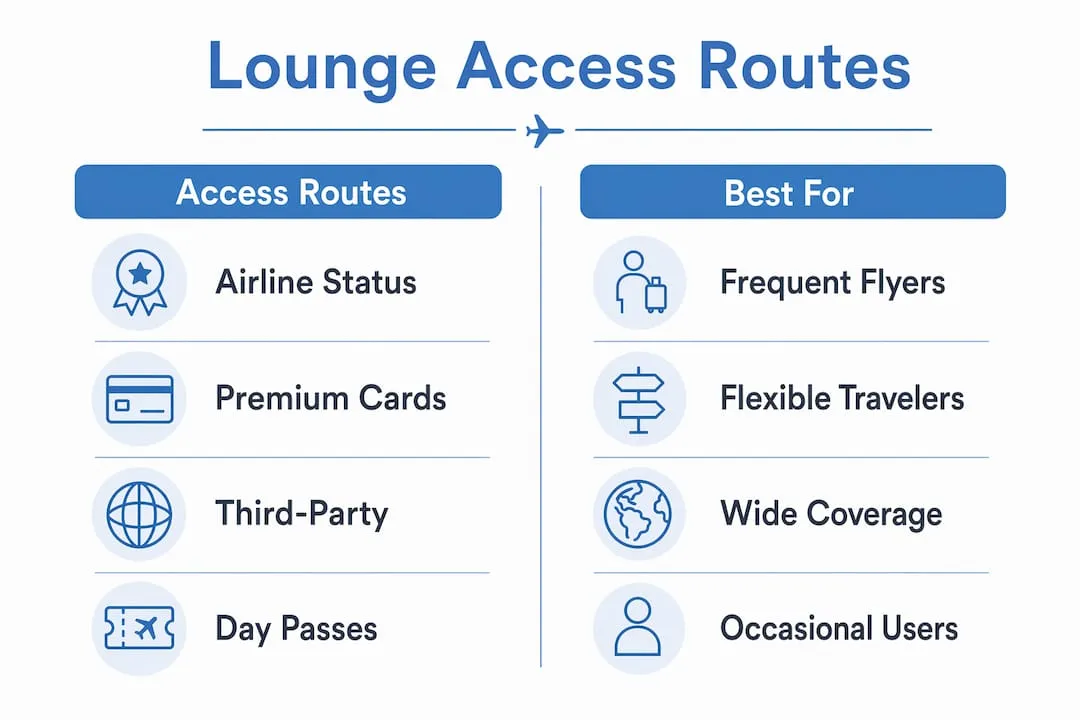
High-end lounges like the Centurion are increasingly capacity-managed for elite cardholders, which means the experience is more controlled but entry is less guaranteed during peak windows.
Step-by-step: how to enroll and actually get through the door
For card-based access (Priority Pass, Centurion, Chase Sapphire):
- Log into your card issuer's portal and locate the lounge benefit under travel perks
- Complete enrollment — this generates a digital membership card, which most lounges now accept
- Download the Priority Pass app and screenshot your card as a backup
- Verify whether your specific card version includes guests or charges per guest
For airline status lounges (Delta Sky Club, United Club, Admirals Club):
- Confirm your status tier qualifies — not every elite level grants lounge access on every fare class
- Check whether your boarding pass cabin class (not just status) is required for entry
- Alliance status (Star Alliance Gold, Oneworld Emerald/Sapphire) can unlock partner lounges when flying a partner carrier
For day passes and LoungePass:
- Buy online before arriving — walk-up availability is not guaranteed, and capacity denials happen even for members during peak hours
- Print or download your confirmation; some desks do not accept mobile screenshots
For Minute Suites:
- Book at minutesuites.com or through the Priority Pass app where applicable
- Rooms are available at Atlanta Hartsfield-Jackson, Dallas/Fort Worth, Philadelphia, Charlotte Douglas, and a handful of other U.S. airports
- Ideal for layovers of 60–180 minutes when a private, quiet room matters more than food or Wi-Fi
Pro Tip: Activate your card's lounge benefit the week before travel, not at the airport. Enrollment processing can take 24–48 hours, and a pending membership card will get you turned away at the desk.
How to make a lounge genuinely low-stimulus once you're inside
Getting in is only half the work. Many lounges now add quiet zones and restricted-phone areas, but you need to know where they are before you sit down.
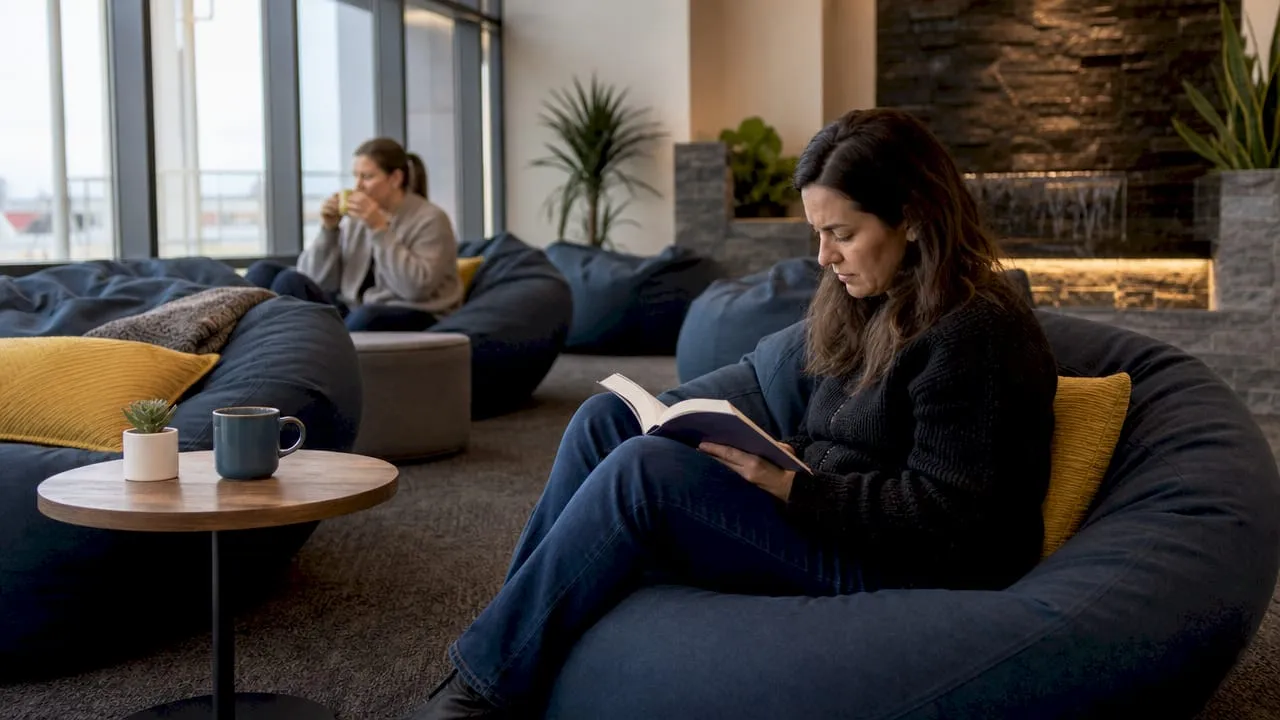
Before you arrive: Check the lounge's floor plan on its website or app. Note whether it has a dedicated quiet room, family zone, or low-light seating area. Arrive at least 2.5 hours before departure — lounges are calmer in the first hour after opening and in the 30 minutes before the main boarding wave.
Seat selection matters more than most guides admit. Corner seats away from the buffet line and near a window give you the most environmental control. Avoid seats directly beside the bar, the TV wall, or the main entrance. If there's a family zone, it's often louder than the general seating area — counterintuitive, but true.
Pack a sensory kit and keep it accessible:
- Noise-cancelling headphones (over-ear, not earbuds)
- A weighted lap pad or small blanket
- A visual schedule showing lounge time, gate walk, and boarding sequence
- A small fidget tool or stim object
- Sunglasses if the lounge uses bright overhead lighting
Pro Tip: Ask the host desk quietly: "Do you have a quieter seating area, or a section away from the main food service?" Most lounge staff will point you to one without any documentation required.
Scripts and templates for requesting accommodations
Knowing what to say, and when, removes a major friction point.
Pre-arrival email to the lounge (send 24–48 hours before): In-person request at the host desk: TSA Cares pre-notification (call 1-855-787-2227 at least 72 hours before): Useful documentation to have ready:
- A brief written note from a healthcare provider (not required, but speeds up some requests)
- Service animal documentation if applicable
- Your lounge membership card and boarding pass together — having both ready prevents desk friction
- A note in your airline profile's "special assistance" field (accessible through most airline apps)
Costs, guest policies, and when lounges actually break even
Priority Pass standalone memberships start at $99/year for the Standard tier, with a $35 per-visit fee for each member visit and each guest. The Prestige tier at $469/year covers unlimited member visits, with guests at $35 each. Day passes at most U.S. lounges generally cost $35–$60 per person.
For a family of three, a single lounge visit via day pass can cost $105–$180 out of pocket. That math shifts when the access is bundled into a card's annual fee — the Amex Platinum's $695 annual fee includes Centurion access and Priority Pass Select, which can offset the cost across multiple trips.
Lounge value is strongest on layovers of 2–4 hours near the lounge's terminal. Under 90 minutes, the math rarely works — especially if the lounge requires a terminal change or re-clearing security.
Key figure: Members can be refused entry during peak times due to capacity restrictions, even with a valid membership. Never build an itinerary that assumes guaranteed lounge entry.
Chase Sapphire Lounges require reservations at select locations, with defined booking windows. Check the Chase portal before travel, not at the airport.
When a lounge won't work and what to use instead
Lounges fail neurodivergent travelers in predictable ways. Plan for these before departure:
- Location friction: The lounge is in a different terminal or requires re-clearing security — impractical for layovers under 90 minutes
- Capacity denial: Valid membership, no entry — this happens most at hub airports during morning and evening peaks
- Quality mismatch: Some credit-card-access lounges are minimal, noisy, and no calmer than the gate area
- Short connections: Any connection under 60 minutes makes a lounge visit logistically risky
Alternatives that reliably deliver low-stimulus conditions:
- Minute Suites: Private, bookable rooms at select U.S. airports — the most predictable quiet option when available
- Hotel day rooms: Several airport-adjacent hotels offer day-use rooms; book 48 hours in advance
- Quiet gate areas: Most large U.S. airports have less-trafficked concourses or gate clusters — Travel with Chance can identify these in advance as part of a visual itinerary
- Private restaurant booths: Some terminal restaurants offer semi-private booth seating away from foot traffic; call ahead to reserve
How Travel with Chance arranges lounge access for neurodivergent travelers
Travel with Chance treats lounge access as one component of a verified, low-sensory travel day — not a perk to figure out at the airport.
What the service covers:
- Sensory-vetted lounge selection based on quiet-zone availability, location relative to your gate, and peak-hour patterns
- Advance enrollment checks to confirm your card benefit is active and guests are covered before travel day
- Pre-arrival staff notifications sent to lounge host desks on your behalf
- Real-time monitoring for capacity alerts, gate changes, and lounge closures during travel
- Live travel-day support to reroute to a Minute Suite or quiet gate area if the lounge is unavailable
- Visual guides showing the lounge entrance, seating layout, restroom location, and gate walk
There are two ways to work together: booking assistance at no planning fee, or custom trip planning for a flat $250.
Key Takeaways
Airport lounge access is most reliable for neurodivergent travelers when enrollment is completed in advance, the lounge location is verified against the departure gate, and a backup option is confirmed before travel day.
| Point | Details |
|---|---|
| Activate benefits early | Enroll via your card issuer's portal at least a week before travel; a pending card gets you turned away. |
| Verify location and timing | Lounges in different terminals or requiring re-security are impractical for layovers under 90 minutes. |
| Carry a sensory kit | Noise-cancelling headphones, a visual schedule, and a weighted lap pad make any lounge more manageable. |
| Always have a backup | Minute Suites or a pre-selected quiet gate area should be confirmed before departure, not improvised on arrival. |
| Travel with Chance handles the logistics | Sensory-vetted lounge selection, pre-arrival staff notifications, and live travel-day support are included in service engagements. |
Why lounges are tools, not status symbols
The conventional framing around airport lounges is almost entirely about status — which card gets you in, which lounge has the best champagne. For neurodivergent travelers, that framing is useless. What actually matters is whether the room is quiet, whether the restrooms are clean and close, and whether you can sit for 90 minutes without sensory input compounding into exhaustion before the flight even boards.
The honest reality is that lounge quality varies enormously. Some Priority Pass locations are genuinely calm and well-maintained. Others are louder and more chaotic than the gate area they're supposed to be an escape from. The difference between a useful lounge visit and a wasted one almost always comes down to advance research — knowing the floor plan, the peak hours, and whether a quiet zone actually exists versus being listed on a website.
The other thing most guides miss: a lounge that requires a 12-minute walk through a different terminal is not a low-sensory option for a family managing a 75-minute connection; the logistics have to work before the amenities matter.
Travel with Chance plans your lounge access before you reach the airport
Most travelers figure out lounge access at the gate. Travel with Chance figures it out weeks earlier, so you arrive knowing exactly where you're going, what to expect inside, and what happens if the lounge is full.
A Travel with Chance engagement includes sensory-vetted lounge selection, pre-arrival staff notifications, visual guides for the lounge entrance and seating layout, and live travel-day support if anything changes. For families, that means guest fees are confirmed in advance, quiet zones are identified, and a Minute Suite or alternative is already booked as a fallback. To start planning a low-sensory travel day with lounge access built in, get in touch and describe your trip.
Useful sources
- Priority Pass program overview — The Points Guy: Covers enrollment steps, membership tiers (Standard, Standard Plus, Prestige), guest fees, and how card-linked benefits activate.
- Chase Sapphire Lounge network — Chase: Confirms reservation requirements, booking windows, and check-in rules for Sapphire Lounge locations.
- Are airport lounges worth it anymore? — The Seattle Times: Reports on capacity management trends, quiet-zone additions, and the split between elite and mass-market lounge experiences.
- Is airport lounge access worth it? Real-world guide — Voyay Blog: Explains the 2–4 hour break-even window and the location-friction problem for short layovers.
- TSA Cares — TSA: Official contact page for requesting a Passenger Support Specialist; call 1-855-787-2227 at least 72 hours before departure.